
AI can help you think, not just write
How to use AI to examine a business idea, question assumptions and prepare customer interviews. A fictional home-cooked lunch delivery example.
Updated:
When you have a business idea, it is tempting to open ChatGPT and ask for a business plan. You may get a neatly organised document with target audiences, an offering and a sales plan. But if you do not yet know who would need your service and pay for it, it is too early for that document.
You can start a conversation with AI much earlier. Bring a rough idea, a dilemma or a question you keep going round in circles about. Instead of asking for a finished text, ask for questions, a comparison of options or a review of assumptions you have not yet checked.
Consider a fictional example: someone is thinking about delivering home-cooked lunches. The business example is fictional. The screenshots show actual ChatGPT responses to this learning example in Slovenian, not market research. The photographs are illustrative.

First, work out what you are assuming
The initial idea goes like this:
“I would deliver home-cooked lunches to people in our town who are too busy to cook. I think there would be enough interest.”
That short description leaves several questions open. Who are these people? What do they currently do for lunch? Is their problem the price, the choice, the wait or something else? Would they order every day or only occasionally?
You can ask AI to help you unpack the idea:
I am considering delivering home-cooked lunches to people working in a small town. The idea is at an early stage. Help me work out what I need to clarify before investing money. Do not write a business plan yet. Ask me one question at a time and wait for my answer. Distinguish between what I know and what I am merely assuming.
Taking questions one at a time gives you room to pause over each answer. You might realise that by “people working in town” you actually mean a few acquaintances at a nearby business park. Or that you inferred the need from your own difficulties with lunch.
That gives you a more concrete starting point.
Ask for reasons, not just a verdict
“Is my idea good?” is too broad a question. Even an encouraging answer does not tell you whether there are enough customers in your town.
It is more useful to examine what success would depend on:
Which assumptions would have to hold for this offering to work? For each one, explain what it would mean if it were wrong. Do not invent data about the local market.
For lunch delivery, for instance, it would be worth checking whether you could deliver enough orders within a short time and a small enough area. A few interested people scattered across the municipality present a different problem from several orders in the same building.
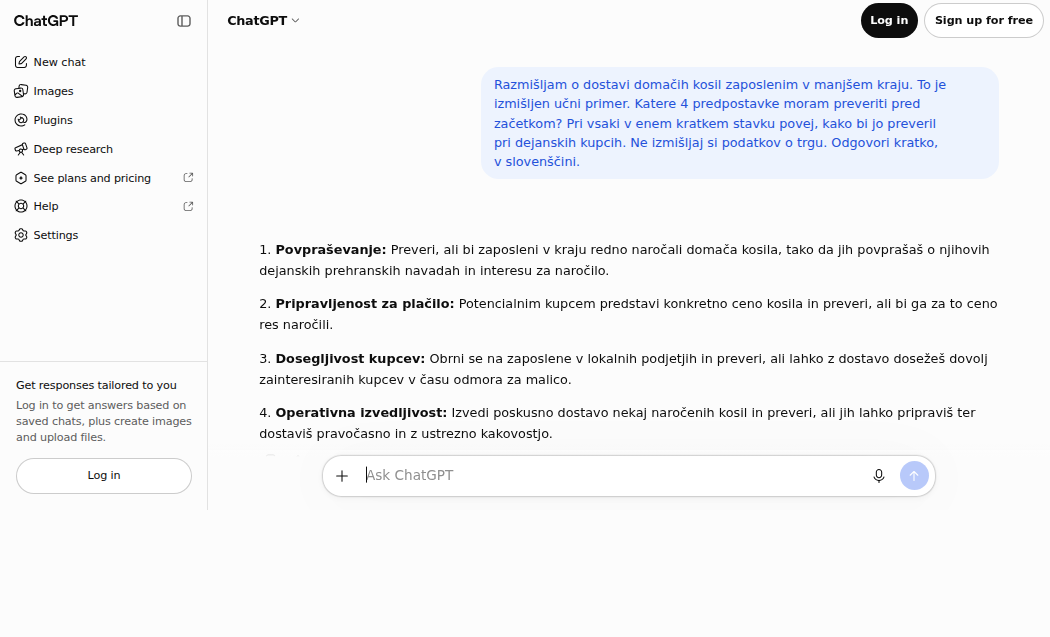
You can then turn the conversation around:
Suppose we launched the service and stopped after three months. Suggest possible reasons specific to this idea. Which could we investigate before starting?
This thought experiment is a way to identify problems worth investigating. AI is not predicting the future. Assess its objections too: which are relevant, which rest on a mistaken assumption, and which could apply to almost any business?
Use the conversation to prepare for talking to customers
At some point, you need information from the people who would actually use the service.
AI can help prepare questions for them. Set a clear constraint:
Prepare five questions for a conversation with people working at a nearby business park. I want to understand what they currently do for lunch and what bothers them about it. Do not ask whether they like my idea, and do not phrase questions to lead them towards a positive answer.
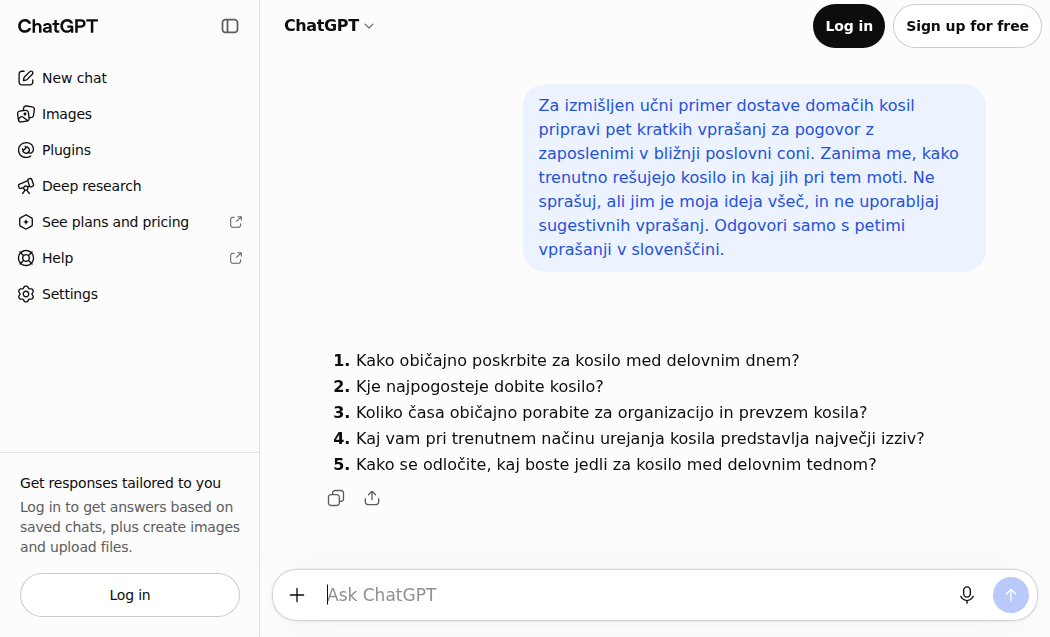
The questions might be:
- What did you do for lunch on your last three working days?
- How much time and money does lunch usually take?
- When does your current arrangement not work for you?
- What alternatives have you tried, and why did you stop using them?
- How do you arrange group orders at work?

The answers will tell you more about their habits than a general question such as “Would you order home-cooked lunches?” You might discover that they already have a satisfactory arrangement. Perhaps the problem only arises on Fridays. Either finding could change your offering before you start preparing menus and a website.
Do not let AI invent your research
You can ask AI to play a potential customer. That can be practice for a conversation, but statements from such a “customer” are not evidence of demand. The same applies to estimates of prices and order volumes if you have no verifiable data to support them.
Once you have collected real answers, you can involve AI again. Share notes with names and other unnecessary personal details removed, and ask:
Find recurring problems and differences between interviewees in these notes. Link each finding to the note it comes from. Identify what we cannot conclude from these conversations. Do not generalise to everyone working in the town.
Compare the resulting summary with your notes as well. If two people mentioned a high price, that does not mean price is everyone's main concern.
Before deciding to launch a delivery service, you would also need to check costs, feasibility and the requirements for preparing and selling food. This conversation covers only early thinking about customers and the offering.
What to take away from the conversation
A useful result from a first conversation with AI is a short note setting out:
- whom you want to help and with which specific problem;
- what you already know about that problem;
- which assumptions still need checking;
- what you will do to get the missing information.
In our example, the next step could be talking to a few employees and the person who organises group orders at a nearby company. A full business plan can wait until you know how these people handle lunch today and what, if anything, they would like to change.