
The AI Act is already in force. What actually changed on 2 August?
Do you need to label an AI image, a business email or a chatbot? A short guide to the new transparency rules through practical examples.
ChatGPT has not been banned by the new transparency rules. Nor does every AI image need a huge “CREATED WITH AI” label. But since 2 August 2026, rules requiring clear disclosure of AI use have applied to certain interactions and types of content.[1][3]
For a business, the key question is: is AI helping you, or are you using it to address the public directly?
An email is not a chatbot
AI drafts a proposal, you review it and send it to a customer. Article 50 does not introduce a blanket requirement to label an ordinary business email like this “written with AI”.[1][3]
It is different when an AI chatbot replies directly to visitors on your website. The provider must ensure that people know they are talking to AI, no later than the first interaction. There is an exception when this is obvious, but the Commission warns that it should be interpreted narrowly.[1]
A practical suggestion: check your chatbot’s opening message. “I’m the company’s AI assistant” is much clearer than “Anna from support” without an explanation.
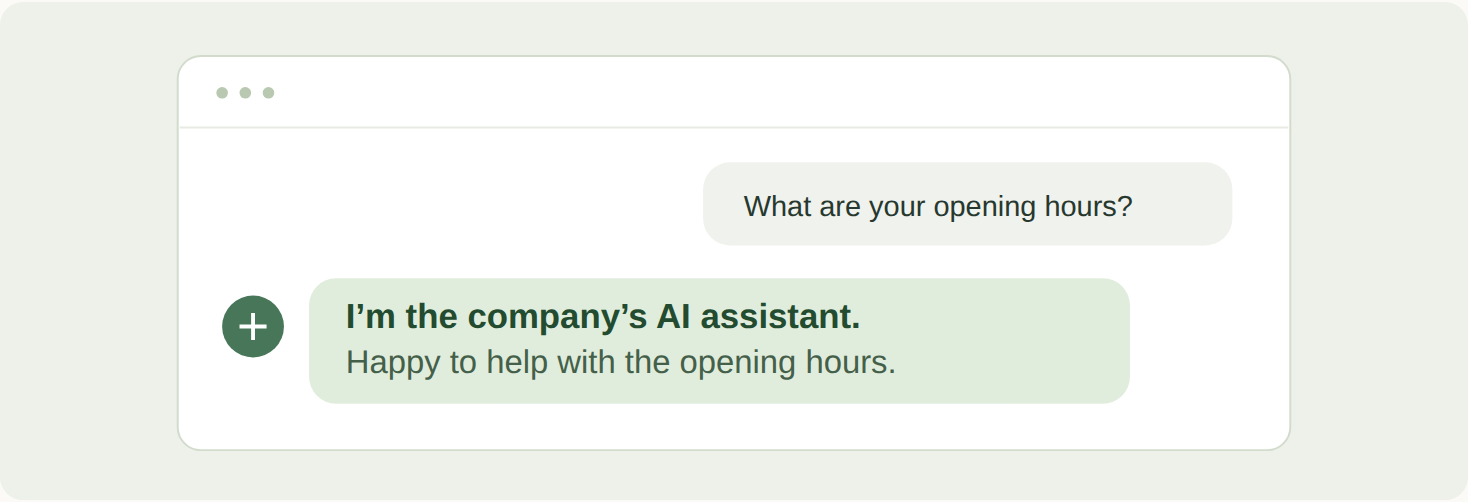
Illustration: Synesis.
An AI image is not automatically a deepfake
The rules distinguish between machine-readable marking, which providers of generative systems are responsible for, and disclosure to the viewer, which businesses using AI must provide for certain content. These are not the same obligation.[1][3]
An obviously stylised illustration is generally not the same as a realistic fabrication of an event. A deepfake is AI-generated or manipulated image, audio or video content that resembles people, objects, places or events and could falsely appear authentic. When used in a business context, such content must be clearly disclosed as artificially generated or manipulated; a hidden technical mark is not enough.[1]
For example: an AI-created “recording” of a director saying words they never said. For evidently artistic, satirical or fictional works, disclosure is adapted so that it does not interfere with the experience of the work. This is not an automatic exemption.[1][3]

Illustration: Synesis.
What about articles written with AI?
A specific rule applies to AI text published to inform the public on matters of public interest. An exemption applies if the text has undergone substantive human review or editorial control and a natural or legal person holds editorial responsibility for its publication.[3]
Fixing commas is not enough. The Commission explicitly distinguishes substantive review from superficial grammar checks.[1]
For a business blog, we therefore recommend a clear process: who checks the claims, who approves the final text and who takes responsibility for publication.
When do the rules apply?
The transparency rules in Article 50 apply from 2 August 2026. For systems placed on the market before that date, however, the Commission states a limited grace period until 2 December 2026, solely for providers’ machine-readable marking and detectability obligations. This is not a general postponement of chatbot or deepfake disclosures.[1]
What should a business do?
Review where AI comes into direct contact with your customers: on your website, in publications and in recordings. Check chatbot notices and disclosures for realistic fabricated content, and assign someone to review the substance of articles.
Start with what a customer might mistake for a human or a genuine recording. That is where a review is most useful.
This article covers transparency in everyday business use of AI, not every obligation under the AI Act. Labelling does not, by itself, make a use lawful. This is general information, not individual legal advice.[3]