
Jev: AI that helps software make decisions instead of writing replies
What if useful AI does not need longer answers, but fast, constrained decisions? That is the bet TypeSafe AI is making with Jev.
Imagine a company receiving hundreds of messages every day. One customer wants a quote, another has a billing question, and a third reports a breakdown. Before employees can start replying, someone has to work out where each message belongs and how urgent it is.
This task does not require an essay. It needs something rather more mundane, and useful: the right department and an urgency rating.
This is the kind of problem Jev aims to solve. On September 15, TypeSafe AI introduced it as the first model in its “System One” family, designed to make fast, structured decisions for software. At launch, it was available in early access.[1]
Less conversation, more decisions
With conversational AI, we are used to asking a question and getting text back. Jev is not designed for that kind of conversation. Software supplies data and precisely defined questions; the model returns choices, scores and probabilities that the software can use directly.[2]
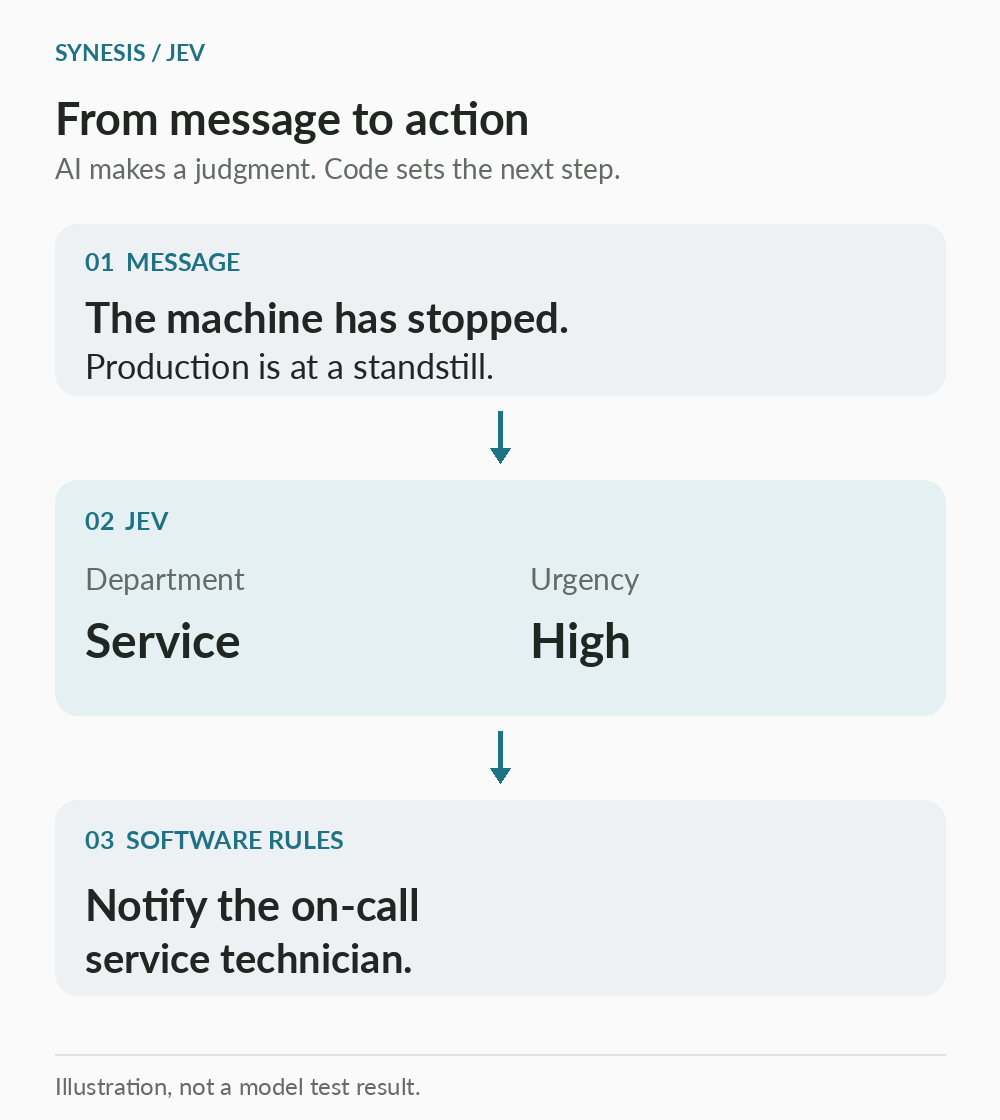
In our hypothetical example, it might receive this message:
“The machine will not turn on. Production has stopped. Please call as soon as possible.”
Instead of a paragraph of explanation, it could select “service” from the allowed departments and assign high urgency. What happens next, whether notifying an on-call technician or simply adding an inbox label, would be determined by the software's rules.
Graphic: Synesis.
Illustration, not the result of an actual model test.
Why could this be faster?
Conventional generative language models build their responses sequentially, one piece of text at a time. TypeSafe says Jev gives up free-form text generation and calculates multiple decisions in parallel. Its documentation explains that questions within a single call are evaluated independently against the same input data.[1][2]
Think of the difference between a colleague writing a report about a message and one filling in a few predefined fields. The report can say much more. But if all you need is the department and urgency, the form is closer to the actual task.
This does not mean other language models cannot produce structured responses. They can, as TypeSafe's own comparison acknowledges. The distinction the company emphasizes is that Jev is built specifically for these decisions rather than general text generation.[1]
The company reports response times of 70 to 500 milliseconds and substantial time and cost savings in its comparative tests. These are the provider's measurements, not a promise that every task will run a hundred times faster. TypeSafe itself notes that the largest published gains are likely at the upper end of real-world benefits.[1]
The choice matters, but so does certainty
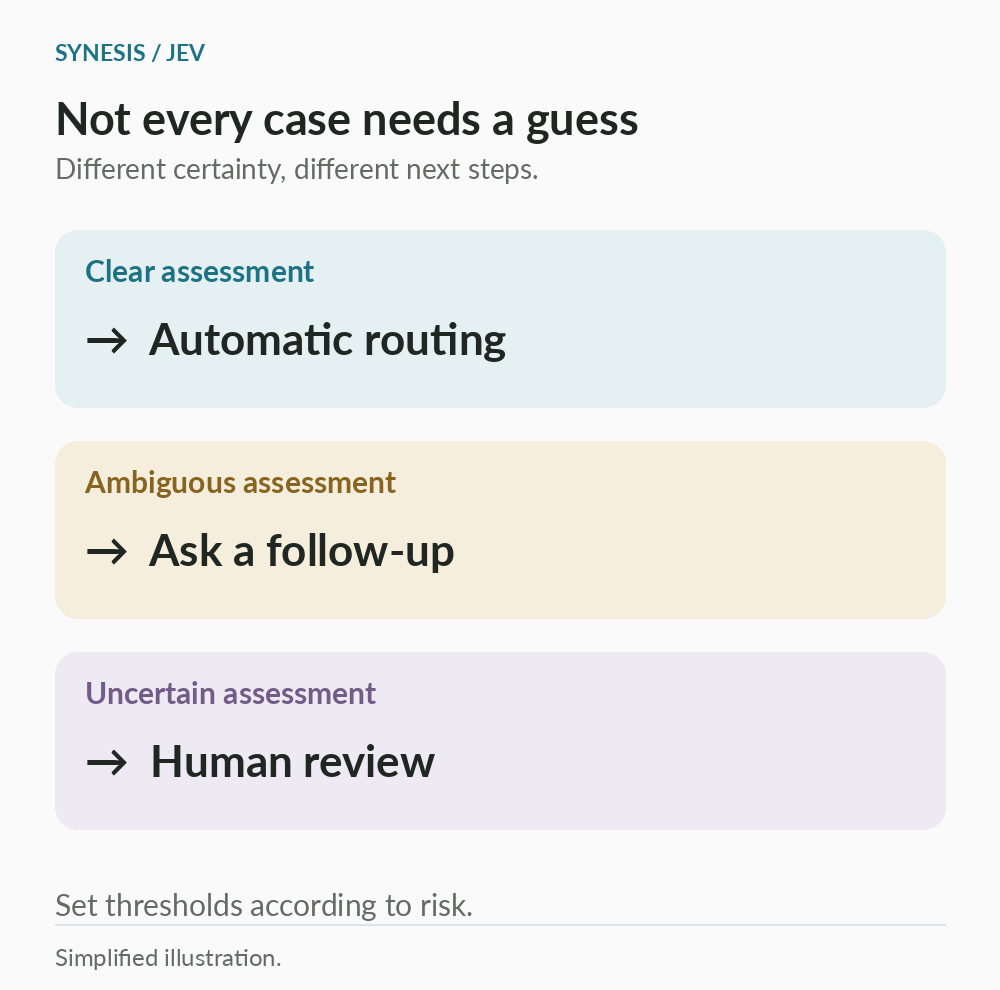
When routing messages, there is a difference between a clear request for service and a vague “I'm having trouble with this again.” A good system should not act without hesitation in the second case.
For choices and scores, Jev returns a probability distribution and a confidence measure derived from it. Software can use this information to take different paths: automatic processing, further checks or handing the case to a person.[3]
Graphic: Synesis.
Simplified illustration. Thresholds should reflect the task and the consequences of an error.
A number alone does not guarantee correctness. TypeSafe also recommends testing thresholds on your own data and adjusting them to the risk.[3] Misrouting a message and incorrectly approving a payment are hardly equivalent mistakes.
“Cannot hallucinate” does not mean “never gets it wrong”
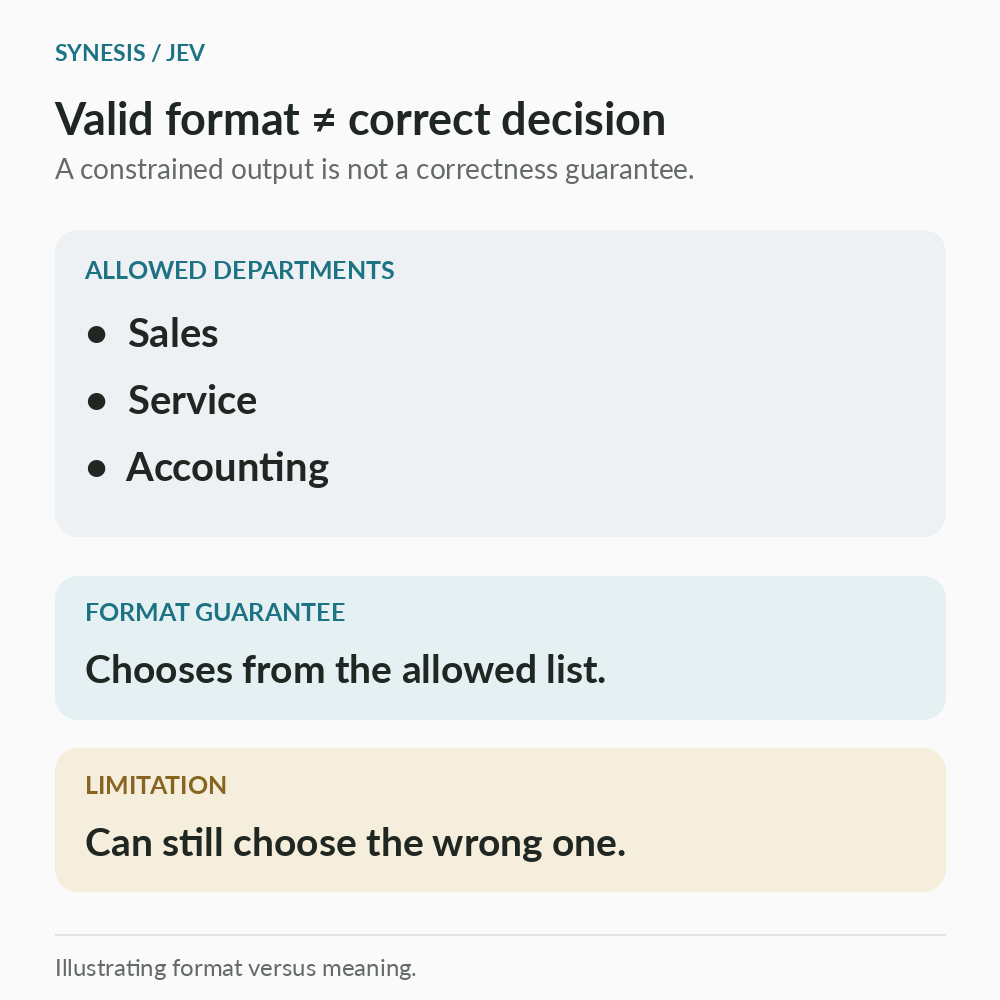
The boldest claim in the announcement is that Jev “can't hallucinate.” It is important to understand what the company actually guarantees: the model's output must conform to a predefined structure and allowed values.[1]
If it can choose between sales, service and accounting, it cannot invent a fourth department. It can still choose the wrong one of the three.
Graphic: Synesis.
This constraint is useful: it removes one class of problems when integrating AI into software. It does not eliminate mistaken judgments, ambiguous inputs or poorly framed questions.
The test results also need to be read in context. In the workflow evaluations presented, TypeSafe compares answers with reference probabilities from other capable models, rather than independently established correctness for every decision. Agreement with other models is therefore not the same as proof that the system is right.[1]
A complement, not a replacement for conversational AI
Jev will not write an article or a friendly reply to a customer: free-form text generation is a capability it deliberately gives up.[1] Its place is elsewhere: classification, routing, scoring and other narrowly defined decisions within software.[2]
One interesting possibility is a combination: one model routes the message, another drafts the response, and software rules determine what requires human approval.
Jev raises a useful question: does AI need to talk for every task, or is a well-constrained decision sometimes enough?
The provider's promises will need to be tested in practice. But the direction itself is interesting: less emphasis on how convincingly AI responds, and more on how usefully we can integrate it into everyday work.