
AI offers a proof for Navier-Stokes. What is left for mathematicians?
OpenAI has published a claimed solution to one of mathematics' hardest problems. Meanwhile, 25 Fields Medalists warn that mathematics is not just about getting the right answer. The question is no longer only what AI can do, but what we want to gain from its achievements.
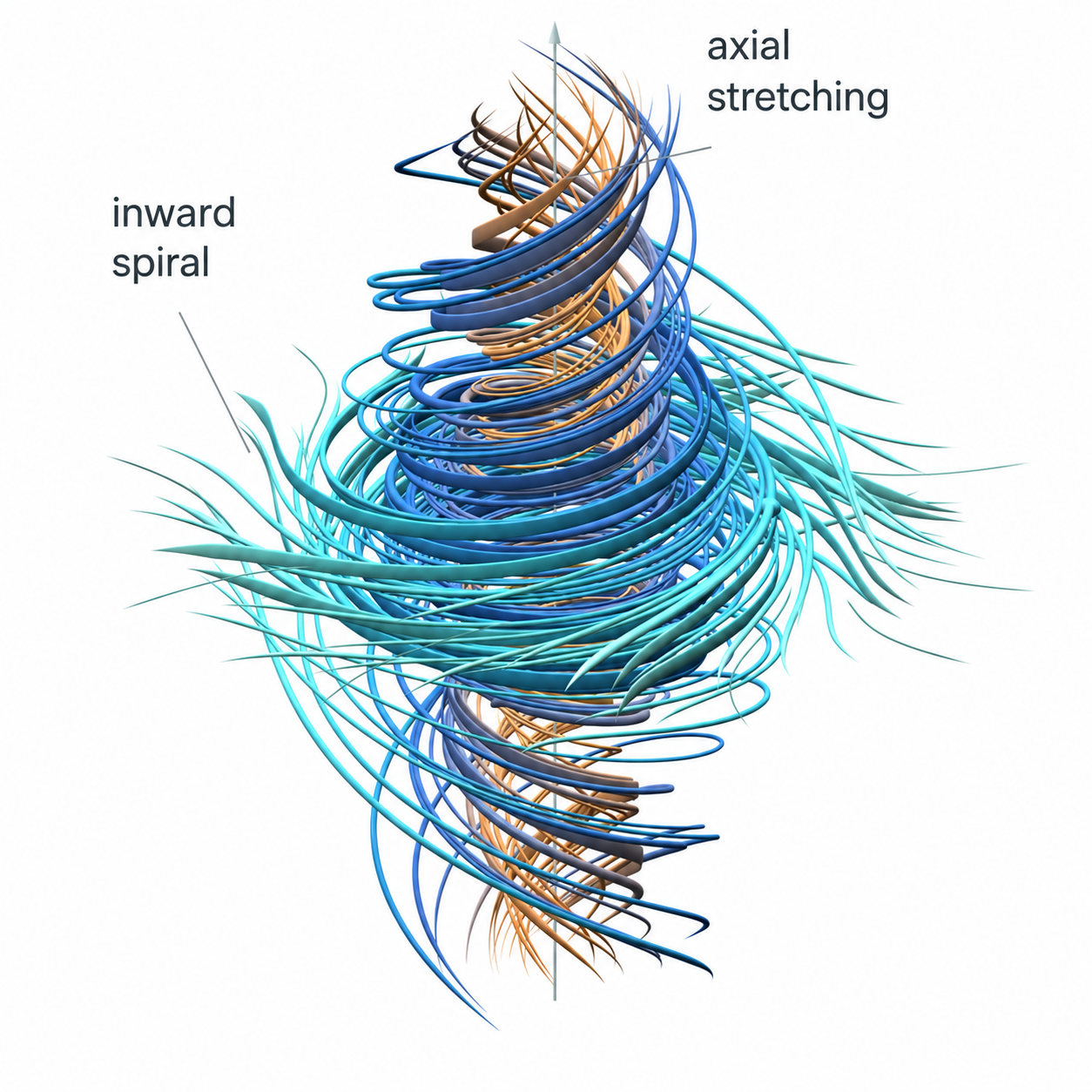
Image source: OpenAI.
Pour milk into coffee and vortices appear. Similarly complex motion occurs in clouds, rivers and the air behind an aircraft. The Navier-Stokes equations describe the motion of liquids and gases, but using them does not mean we understand everything they mathematically allow.[4]
On September 8, OpenAI published a proof it claims resolves the famous existence and smoothness problem for these equations.[1] If the result survives independent scrutiny, it will be an important mathematical achievement. It also raises a question that reaches far beyond fluids: what happens to expertise when a machine reaches an answer faster than people can understand it?
What exactly has been solved?
Very roughly: can motion in a mathematical model that starts completely smooth become so extreme in finite time that the smooth description breaks down? Such a point is called a singularity. Viscosity, the fluid's internal friction, dampens motion; the question is whether that always suffices.[1]
OpenAI says it has constructed a case in which a singularity develops despite viscosity. An important detail is that a smooth external force acts on the fluid. This is not a claim that every ordinary vortex will spontaneously turn into something infinite.[1] Nor is it a prediction that real water will reach infinite speed. It concerns a limit of an idealised mathematical description, not the removal of physical constraints.[1]
The result should not be attributed to an ordinary ChatGPT conversation either. According to OpenAI, an internal model more capable than Astra produced it in a system with around 10,000 concurrent agents. Astra subsequently participated in formalising and checking the proof in Lean.[1]
A published solution is not the same as a completed expert review. At the time of writing, the Clay Mathematics Institute still labels the problem active on its website.[4] We are therefore reporting a published proof and its authors' claims, not a fully completed process of recognising the solution.
What did 25 Fields Medalists sign?
Twenty-five Fields Medal recipients, including Terence Tao, Peter Scholze and Maryna Viazovska, signed A Severe Misalignment of AI in Mathematics. Its message is that the goals of companies using solved problems as a measure of AI capability can diverge sharply from the goals of mathematics.[2]
The signatories do not argue that AI has no place in research. They explicitly recognise its potential to accelerate genuine mathematical understanding.[2] They warn, however, that mass-producing answers of “true” or “false” is not equivalent to developing new ideas.[2]
A famous problem can serve as a lighthouse, giving researchers direction. The search for a solution produces methods, connections and new questions. Explanations, discussions and simplifications follow, until a once inaccessible result can become material students learn from. That journey is central to the declaration.[2]
If we preserve only the final proof, we may have met the competition's goal without gaining everything that made the problem worth studying.
Tao: the answer is not the whole achievement
Speaking to IBM Think, Tao warned that the speed of problem-solving could outpace the slower work of developing methods and understanding why they work.[3] His concern is not only whether a particular proof is correct, but what might be missed in the rush to the next result.[3]
It helps to separate two questions. Does the conclusion follow from the assumptions? And: what idea explains why it does, and where else can that idea be used?
A formal proof checker such as Lean is designed to check formally written proof steps. OpenAI has published such a formalisation.[1] But confirmation of a formal statement is not, by itself, an explanation a researcher understands and can apply to a new problem. It is also necessary to check that the formal statement matches the question we intended to solve.
Where, then, is AI's limit?
This achievement, if confirmed, does not establish that AI can solve every mathematical problem. Nor does it establish a safe boundary beyond which new ideas will always remain exclusively human.
It would be too comfortable to say that machines will prove things while humans will forever be the only ones who understand. AI can also help with explanations, simplifications and connections. The declaration does not rule out that development; the question is whether we will encourage it as energetically as the pursuit of the next famous problem.[2]
An important constraint may therefore shift. Not just “can we get the answer?”, but “can we check it, explain it, connect it to other knowledge and teach it to the next generation?”
For mathematicians, that need not mean the end of research. It could open up questions previously beyond reach. But if the way proofs are produced changes, education must be reconsidered too: how do we train someone to judge a result if a tool always performs every demanding intermediate step?
Other professions face the same question
The declaration explicitly connects mathematicians' situation with other scientific and creative professions: years of work have served not only to produce a final result, but also to develop judgment and new questions.[2]
The comparison is useful, although verification works differently across fields. Mathematics can formally check reasoning from assumptions. In medicine, a hypothesis must survive contact with patients and research. In engineering, a solution must work under real conditions. A polished document or a correct calculation does not yet guarantee a good outcome.
This is not a reason to treat slowness as a virtue. If AI can remove months of routine work, that is an opportunity. But it matters to distinguish work we can dispense with from work through which the ability to think independently develops.
The most interesting question around Navier-Stokes is therefore not whether mathematicians have become redundant. It is whether AI will merely help us close old questions faster, or enable us to ask better new ones.